At the beginning of my first term this University year, I had already had lots of ideas for this project floating around my head, ideas that have developed throughout my previous two years. But one thing that was mentioned to us at the very beginning was that we could inter-link our projects together to make it a bit easier for us. I thought that this was a great idea for me as I already knew that it would help me a lot on research purposes. Having a similar idea for both my Major Practical Project and my Mixed Media assignments means that I will have a lot of research to back both projects and therefore makes looking for artists and photographers with similar ideas to my own, that bit easier.
The Actual Link
My main idea for this project was to develop from my rather successful nude images I created within my first year. The nude images were on locations, one set inside a house by a window and the other set in a garden. I really liked them and thought that they were great for giving me my initial style of work as it is a genre I am very interested in. Anyway, I wasn't exactly sure that I wanted to create more nude images for this project or to just work from them to a similar style, so my ideas changed into looking into the 'body' and 'body movements'. Working with the human body and its shapes, tones and movements with nude, so that I am still exploring the look of the body through a nude/artistic and photographic way.
So, the link between the two projects is that one is purely photographic, this Major Practical Project, and the other includes the works of different medias, Mixed Media Project. So i've decided to use the same topic of 'body & body movement' for both projects but to have different outcomes that look completely different. Because of body movements, I have looked into dance photography and linking the body in with dance. This is one big link in the topic I have chosen as dance is also one of the main focuses as well as the body as a shape and movements. Here are what the two outcomes will hopefully be, ideas may change along the way:
Mixed Media: I am creating a short dance film, including one or more dancer/s that will be filmed from different angles and compositions or from a still camera, to create a 2/3 minute film, showing slow motion movements of how the body moves.
Major Practical Project: I will create a series of roughly 10 images showing either dance portraits or working with motion and motion photography of how a dancer moves, and capturing them in creative imagery.
The two projects will link through possibly using the same dancer for both. This shouldn't be a problem as both project's outcomes and final creations will look completely different from one another. The same topic and similar styles will help with research as I may be able to use the same artists work to show but use them for looking at different aspects, for example; watching a dance film could give me an idea for a final image in my photo project whereas, looking at a certain angle of a photograph could give me an idea for my film.
Creating two similar-ish projects will also help my professional side to my photography as it will help me to create my 'style' of work in 'Suzi-Rae Photography'.
Sunday, 3 February 2013

Overlook of the Module Objectives
So, this is just a blog post to reassure me of exactly what I need to do and what I need to have for the final hand in for this assignment. I like to have a list of everything so that I can scroll back and use it almost like a tick list so I know I'm staying on track. I was only going to list the module outcomes, but I'm going to run through everything that I need to do from the original brief, in simple bullet points as it's much simpler to read quickly. =)
Assignment Context:
Critical Journal:
Module Objectives:
Module Aims:
I know that each bullet point made in this post is achievable for me with the ideas I have. I need to be focused and positive towards my time management and my organising skills to be able to complete as much as I can do. The approx. 10 final images will be produced and ready on a CD as well, as I know that will be easy, and so far on my blog I have shown inspirations and examples of my ideas. I know I have a lot more to show and influential work from other photographers that have work similar to my theme. One thing I do need to think about it how I will display my images at the end of year Exhibition and how many images I will show, but this is something I can think about once this project is complete.
A Statement of Intent was originally wrote out in my first proposal, but I have since had changes to my ideas and my final outcome will be different to what I mentioned, so therefore, I will need to write out a new statement. My writings and jottings, will be documented along the way, I just need to remember to include everything that I have seen, relevant to my them and style of work. Rejected work is also something I will definitely include, once I have shot my final images, I will include previous shoots and ideas that have changed. Evaluations will be last about my shoot and how my planning up to the shoot worked out.
As far as the Objectives go, I think demonstrating and producing a focused practical project should be ok for me as I am really interested in the style, theme and path that I am going along in my topic. Learning my own work-in-progress is something I have already done, showing both my group my ideas and talking through the 'body' research I have done already with Tutors. Conceptual, technical and creative accomplishment will be something shown once the final images are completed and a critical engagement between the theory side to all my work and the practice side will also be something explained and talked about near the end of the project and after the final images.
I aim to be able to tick off each module aim, by the end of the project. I like to think that I usually do, but for this major practical project I am definitely going to keep checking them to make sure. Independent and in-depth research is something I am currently undertaking with my photography related topic of 'body movements', self-responsibility and organisation, honesty, could have been better, but this is due to idea changes, but the problem solving from beginning to end of project will be used, as i have already.
Like I said, I will keep coming back to these bullet points to make sure I stay on track and complete everything I need to.
Assignment Context:
- Submit a Portfolio of normally 10-20 Exhibition Standard prints, relating to the set theme,
- Have a copy of all images on DVD/CD, photographed and processed by me,
- Images demonstrating acquired skills relating to my advanced photographic practice,
- Portfolio is an Open Brief with a Critical Journal as a Blog (this blog),
- Brief is down to me, explore other photographers that have done similar themes,
- Acknowledge other photographers work in my Critical Journal Blog,
- The marks will be given at the Sidney Cooper Graduate Show.
Critical Journal:
- A written Statement of Intent (200-400words max),
- Supporting Materials,
- Writings / Jottings / Influences,
- Test Strips / Contact Sheets,
- Any rejected work,
- A critical Evaluation of Portfolio (one or two sentences per image),
- Any risk assessment paperwork.
Module Objectives:
- Demonstrate the ability to define and produce a focused and sustained practical project,
- Manage effectively my own learning and report on work-in-progress to both, group and tutor,
- Display conceptual, technical and creative accomplishment and skill in photographic practice,
- Show in writing a critical engagement with the relationship between theory and practice.
Module Aims:
- To facilitate my development of an extended, independent and in-depth piece of visual research on a Programme-related topic,
- To encourage me to further pursuit of practice raised by work undertaken earlier in the course,
- To provide a forum for the culmination of my practical learning experience,
- To promote my self-responsibility, organisation and problem solving skills from early conceptualisation through to exhibition presentation.
_______________________________________________________________________
I know that each bullet point made in this post is achievable for me with the ideas I have. I need to be focused and positive towards my time management and my organising skills to be able to complete as much as I can do. The approx. 10 final images will be produced and ready on a CD as well, as I know that will be easy, and so far on my blog I have shown inspirations and examples of my ideas. I know I have a lot more to show and influential work from other photographers that have work similar to my theme. One thing I do need to think about it how I will display my images at the end of year Exhibition and how many images I will show, but this is something I can think about once this project is complete.
A Statement of Intent was originally wrote out in my first proposal, but I have since had changes to my ideas and my final outcome will be different to what I mentioned, so therefore, I will need to write out a new statement. My writings and jottings, will be documented along the way, I just need to remember to include everything that I have seen, relevant to my them and style of work. Rejected work is also something I will definitely include, once I have shot my final images, I will include previous shoots and ideas that have changed. Evaluations will be last about my shoot and how my planning up to the shoot worked out.
As far as the Objectives go, I think demonstrating and producing a focused practical project should be ok for me as I am really interested in the style, theme and path that I am going along in my topic. Learning my own work-in-progress is something I have already done, showing both my group my ideas and talking through the 'body' research I have done already with Tutors. Conceptual, technical and creative accomplishment will be something shown once the final images are completed and a critical engagement between the theory side to all my work and the practice side will also be something explained and talked about near the end of the project and after the final images.
I aim to be able to tick off each module aim, by the end of the project. I like to think that I usually do, but for this major practical project I am definitely going to keep checking them to make sure. Independent and in-depth research is something I am currently undertaking with my photography related topic of 'body movements', self-responsibility and organisation, honesty, could have been better, but this is due to idea changes, but the problem solving from beginning to end of project will be used, as i have already.
Like I said, I will keep coming back to these bullet points to make sure I stay on track and complete everything I need to.
Tuesday, 29 January 2013
Man Ray on : 'The Body'
Man Ray was one of the first photographers that I learnt about around 4 years ago in college. He is an American artist but spent most of his career in Paris. He was described as a modernist and played a big part in the Surrealist movement. In my previous post I mentioned how Bill Brandt was an assistant to Man Ray, so therefore his work could come from and have significance to Ray's work. Man Ray is best know in the art world for his avant-garde photography. He produced work in a range of medias but considered himself a painter, he was also a renowned fashion and portrait photographer. He is noted for his photograms, which he renamed 'rayographs' after himself.
This large image is one of Man Ray's most popular images for nude photography and almost every photographer has seen it before. It's one of those images that you just always remember. I think it looks very elegant and holds a peaceful sense of calm, much like the instrument that this female model looks like.

Nude art has remained an essential focus of Western art, artists from the seventeenth century to today, have privileged the nude form and made it an endlessly compelling means of creative expression. Expression is key when photographing a nude in this case, as the expression of the overall image will determine whether or not the image is aesthetically pleasing. Man Ray, quite clearly uses the shadows and shapes well in some of his nude images, but you can almost definitely see the surrealism within each one. The nude itself is quite prominent with his images, the top half of the female nude seems as if it is the most concentrated part of the body whereas other nude series looks at all parts of the body, saying this I do think with Man Ray's work your still do not feel as if you are looking at a naked body, You see the art side, whether it be by the positions, or editing.

After looking at the nude's of three famous photographers, Sally Mann, Bill Brandt and Man Ray, I definitely know what makes a 'nude' a 'nude', I still find all of the images fascinating from all three artists, and still want to test out some more nudes of my own. Looking at the body is really helpful to my ideas, for all different positions, angles, shapes and these can all be used in my body movements work.
Bill Brandt on : 'The Body'
As well as the previous blog post about Sally Mann, I also want to look at Bill Brandt's work again. This work always inspires me and make me want to get creative and work on nudes again.
Bill Brandt had once been called England's greatest modern photographer! He was born in germany, launched in Paris and is still called a great English photographer. Bill Brandt was a studio assistant to Man Ray. He started documenting class differences in England during the depression (1936), he produced two series of night out, one is Paris (1932) and one in London (1938), and then got jobs at a number of publications.
Brandt moved on to a very avant-garde view of European painters and sculptors, these photographs seem to be more like studies of sculptural form than depictions of the human body. So, he started as Man Ray's assistant in the 1920's, and post-war and after Surrealist interests started his role as a photographer - he stopped doing documentary style photography and started creating more imaginative, aesthetic images that led to concentration on the female nude as his principal theme. I have shown some of his nude images here below that I think look very sleek, unique and sophisticated.
 Throughout all of his nude images there is a slight distortion with the human form, he shows the body through camera angles and manipulation of the arms, legs, feet and fingers and shows poses and positions that resemble objects in Surrealist painting and sculpture.
Because of the manipulation of the body parts and figure, the nudes look like studies of sculptural form. I find that the images have a quality thats irresistible. Knees, arms, fingers and toes acquire a shocking aesthetic interest. His black and white photography brought some of the blackest blacks in photography and is simply smooth, and elegant.
I love all of the above images and think that they do the female body justice to look beautiful, The positions on the rocks look great and the shadows look great to pick up detail and shapes. But my favourite Nude images by Bill Brandt are these five images below. I think they look beautiful and sleek and smooth. I was very thankful to get quite a lot of praise on my nude images I done, but I would like to try out this technique and try using the body to create different shapes.
 I particularly like the centre images of the knees and elbow, it almost seems as if they are rocks balanced on top of each other, rather than being body parts, to be able to get the look of something, almost like a landscape is a great effect. The two females sitting on a rock at the bottom left also look like two rocks, they way the sun light is shining on their backs gives off such a smooth look. Female legs are great to use in nude photography as you can do quite a lot of positions with them, they can create straight lines as well as curves and bends to, like said earlier, create images that looks like sculptures.
I was close to creating a sculpture for my Mixed Media assignment and Bill Brandt's work would have been a great source for that. But as far as my ideas on my major practical, I am still looking into the body - all images from all my inspirational photographer's will help to give me ideas for my 'body' images. I know that I can consider looking at different shapes to create great effects.
Bill Brandt had once been called England's greatest modern photographer! He was born in germany, launched in Paris and is still called a great English photographer. Bill Brandt was a studio assistant to Man Ray. He started documenting class differences in England during the depression (1936), he produced two series of night out, one is Paris (1932) and one in London (1938), and then got jobs at a number of publications.
Brandt moved on to a very avant-garde view of European painters and sculptors, these photographs seem to be more like studies of sculptural form than depictions of the human body. So, he started as Man Ray's assistant in the 1920's, and post-war and after Surrealist interests started his role as a photographer - he stopped doing documentary style photography and started creating more imaginative, aesthetic images that led to concentration on the female nude as his principal theme. I have shown some of his nude images here below that I think look very sleek, unique and sophisticated.

Because of the manipulation of the body parts and figure, the nudes look like studies of sculptural form. I find that the images have a quality thats irresistible. Knees, arms, fingers and toes acquire a shocking aesthetic interest. His black and white photography brought some of the blackest blacks in photography and is simply smooth, and elegant.
I love all of the above images and think that they do the female body justice to look beautiful, The positions on the rocks look great and the shadows look great to pick up detail and shapes. But my favourite Nude images by Bill Brandt are these five images below. I think they look beautiful and sleek and smooth. I was very thankful to get quite a lot of praise on my nude images I done, but I would like to try out this technique and try using the body to create different shapes.

I was close to creating a sculpture for my Mixed Media assignment and Bill Brandt's work would have been a great source for that. But as far as my ideas on my major practical, I am still looking into the body - all images from all my inspirational photographer's will help to give me ideas for my 'body' images. I know that I can consider looking at different shapes to create great effects.
Sally Mann on : 'The Body'
I have written about Sally Mann's work plenty of times throughout my photographic life so far. There is so much to say about all of her series of work and especially about the large format camera she uses too. She has worked with a rage of different subjects but the most popular being her family album series'. Because I have written about her and her work so many times, I'm keeping this blog post short.
This first set of images at the top is from her 'Proud Flesh' series. This is a moody black and white nude series of 'Larry' and his form. Photographed using an 1850's method of collodion wet plate, creating a large-format negative image on glass, not film.
I think the images are very interesting, especially being wet plate collodion, because like she says, the effect on the glass is very mysterious and extraordinary. I like the look of these as nude images and I think she works really well with the human body as a form. She has a way of making it look so peaceful and calm.


 I like that within this series, and although it is capturing her own children's childhood, she also lets them have their own voice in the images, you can definitely tell that it shows each of their own personalities in the images. I think some of her images can be said to be too much to the public eye and they do not like to link the child pornography into it, but if you jus think about the images themselves, I think Sally Mann definitely has a great technique of capturing the 'body' and can show this through emotion and reality. I have included quite a few of her images in the blog post as I think you really get the whole picture when seeing more of the series.
 These three bottom images are lovely, I have actually written a short essay on Sally Mann's issues about the child nude controversy before and agree and disagree to many things said about her work, but these three images are just beautiful. Ironically, I had to discuss the image to the left of Larry, her husband from 'Proud Flesh' series in my Interview to get into University. I think the picture quality is great and the way the lighting has been used for all three looks stunning. The positioning and thought behind each image is there and she knows how to take a good photograph.
Overall, the way Sally Mann captures the body and pays so much attention to the human form, for me is inspiring. I would like to take away some thoughts from her works and put them into my own, When I photograph the body for this project, wherever my ideas take me, I need to pay attention to how the body moves and how the light will fall.
This first set of images at the top is from her 'Proud Flesh' series. This is a moody black and white nude series of 'Larry' and his form. Photographed using an 1850's method of collodion wet plate, creating a large-format negative image on glass, not film.
"It's almost oneiric, it's almost dreamlike the way we move; each one of us knew what we had to do and we weren't talking," Sally says. "But there was something very quiet, very loving about the whole process - his willingness to go through it and also his encouragement of me."She says she's like the opposite of a lot of photographers because she doesn't like everything to be in focus, she wants it out of focus and wants it to be mysterious. This series 'Proud Flesh' is great for that because there is a milky light and shadow playing across her husbands body. She says she was showing a love story between her and her husband, not because of the illness he had.
I think the images are very interesting, especially being wet plate collodion, because like she says, the effect on the glass is very mysterious and extraordinary. I like the look of these as nude images and I think she works really well with the human body as a form. She has a way of making it look so peaceful and calm.

_______________________________________________________________
The rest of the images on the blog post are of her family from the series 'Intermediate Family' and 'Family Pictures'. She had taken all of these images at her home over the years and then had an exhibition held for all of them - not knowing the media attraction she was going to have with them. The photographs are mainly of her three children, Emmet, Jessie and Virginia. To her they were maternal photographs of her children but to others they were of child pornography. This series 'Intermediate Family' shows us situations that happen throughout childhood. Mann chose to explore the concept of childhood and 'growing up' using sensual and reality.

In most of the images the children appear nude or partially nude. In some images where she has the 'child' in full frontal nude some people have commented on there being a huge difference between the gender, but they caused a lot of controversy, and many chose to ignore the images rather than read titles and understand from her point of view. I personally agree with some of the controversy about these images and agree that all of them could be taken out of context by first glances, but I think it is a beautiful series and when I start to think about my childhood, certain image remind me of my own, Sally had only shown reality, but most viewers think and speak too soon.
 I like that within this series, and although it is capturing her own children's childhood, she also lets them have their own voice in the images, you can definitely tell that it shows each of their own personalities in the images. I think some of her images can be said to be too much to the public eye and they do not like to link the child pornography into it, but if you jus think about the images themselves, I think Sally Mann definitely has a great technique of capturing the 'body' and can show this through emotion and reality. I have included quite a few of her images in the blog post as I think you really get the whole picture when seeing more of the series.
Overall, the way Sally Mann captures the body and pays so much attention to the human form, for me is inspiring. I would like to take away some thoughts from her works and put them into my own, When I photograph the body for this project, wherever my ideas take me, I need to pay attention to how the body moves and how the light will fall.
The History of the 'Nude'
So, still thinking about what was said in my feedback e-mail, I need to focus on my main point of interest for this project. The whole general idea for my major practical project and mixed media is about the body and body movement. I have looked into this as a topic many times but want to over-run things so that it is all fresh in my head for ideas for my final work. I have produced nude images before and it's a genre that I think can be quite fascinating, looking into the nude and the body itself is my aim.
Looking into the History of the Nude can really benefit me to find out how many images of the body positions and compositions actually came about. History dates back quite far when it comes to the 'Nude' image, and it has changed one hell of a lot through the years up to today. There are thousands upon thousands of nude images today but all separated into different genre's, there tends to be a fine line when it comes to the debate of it being art, or not art.
Images of sexuality and nudes date back through history, but there are people today that do not think nudes art art at all. Some people class nude imagery as porn, while some people think an image of the naked body is un-nessecery. I personally love the human body and think it is a fascinating thing. Our physical form can produce so many unusual shapes and movements that I think (with a healthy body) can look amazing. The way we function and move and do different things in our lives can be beautiful in photography.
 Photography is a subject I have studied for many years now, and have learnt all about how the form was started, the deguerrotype was created in 1839, and this is thought to be when photography was born. The earliest and oldest 'photograph' was technically by Niepce in 1826, the deguerrotype was the first practical widespread process. As far as nude photography is involved, the first nude photographer is not really known, but N.P. Lerebours (1808-1873) photographed artist's models in 1840, a year after photography was initially created, so is the first nude photographer. In 1841 Voitlander was producing faster lenses that reduced the exposure to 1.5-2 minutes and later in the year new emulsions were developed that allowed exposures of only seconds, this is how the field of portrait photography started, and also the right technical side for nude.
Eugene Durieu was one of the first photographer's is actually try out nude photography, he was commissioned to shoot nudes for Delacroix (a painter in 1850). Durieu was a french man and lived right through the beginning of photography from 1800-1874. Many painters thought photography was a threat to their art works, which is understandable and photography was the new thing, but Delacroix recognised that there was a big difference between the camera vision and the human eye vision. Photography was soon to be a great benefit to art and to artists and lots of artists found it easier to paint from the photo than from life.
Nadar was a French photographer who was well known for photojournalism, began taking pictures in 1853, he did quite a few nude images for different artists. Other photographers in the nude photography field were Baigneuse-Auguste Belloc, Bruno Braquehais - Reclining female nude -1850s and Julien Vallon de Villeneuve. The links all show at least one of their nude images, they look so good for 1850's nudes, because nude photography today seems like it has a completely different vibe to them whereas the work from these photographers show a sense of calm and peace. Here below is a selection of these artists nude photographs.

After these established photographers has created nude photographs for some years, the era of 'the naughty "French Postcards" was around. The naughty postcards was from 1900-1920. The golden age of picture postcards from Paris, this came some of the naughtier of nude's. I would love to get my hands on one of these old vintage books that show all the old postcards and who made them and how they were produced, it would be so interesting to see how nude photography was in the 1920's. Photographers from this period uncover the relationship between postcard eroticism and magazine illustrations, decorative art, and primitive cinema. Attention is paid to the use of sexual symbolism that many of the cards show, valuable sights into the mores and fashion of Europe at the beginning of the century. Some images show popular themes and styles, dis-robing for their baths which brings in seduction (which is a whole other side to nude photography). I think they look fantastic, and was a great idea into the way nude photography was changing. Here below are just some of the naughty french postcards.

Gaudenzio Marconi (1841-1885) took over the studio of Belloc and began shooting nudes for the sculptor Rodin. There is a lot of people that think that Manet's famous Olympia was painted from a photograph, rather than from life, this would mean that no credit would be taken for the photograph itself but for the finished painting, so viewers wouldn't even know it had been taken.
Eadweard Muybridge was producing multiple exposures of nudes by the late 1880's in his various scientific researches into motion. This is a topic that I have looked into many times before, and am particularly interested in for my ideas. Around 1900 Wilhelm von Gloeden and W.Pluschow rejected the Pictorialist soft focus and produced their nude works in a precise and sharp focus and erotica was born. Von Gloeden was mostly known for his male nudes posted in Homeric themes.
So, by the early 1900's the figurative nude was well established. Because of this, something new was bound to come along very quickly, a new technical age brought advances and new art movements were beginning to affect how the nude was presented.
Man Ray, of who's work I love, embraced surrealism which had a tremendous affect on photography and produced amazing works of art. Andre Kertesz, Frantisek Drtikol, and many other photographers were experimenting with distortion, solarisation, and abstraction in the nude form. Edward Weston at around the same time focused on lighting the body in his images, he works on form and light are legendary. Here are some photographs below of the mentioned photographers.
And finally, by the 40's nudes, pin-ups and figure photography was as varied and complex as any other art movement and most of the work in todays nude photography are established by these photographers. Although in todays world there is a fine line between the pornographic and art, there are still many photographers that capture the nude in beautiful ways. This genre has changed dramatically through the years since it started, but all for the good, and some believe the bad, but now anyone can express a nude image in the way they want to. All nude body imagery are the way they are today from these photographers that made the path to the way we see them, over 100 years old and you can now take almost any kind of nude and it could be acceptable.
What I like about Nude Photography
In an earlier post I wrote a little about Klaus Kampert, who's nude work is absolutely stunning because of the simplicity of the body movements that can give such amazing shapes. His lighting is perfect and the way the skin shines in different lights, shadows and shapes is what I like to see in nude photography. If I was to say what I like in photography, it would probably be everything that Kampert shows in his. I love how creative he is with his nudes and how the lighting falls on the body throughout different movements. Movements of the body is also what I have and interest in, and it had a huge link with nude, because of showing how the body moves is easier in nude. I also like how Kampert's work is different yet simple too. His work has a big link into dance photography which is also what I am looking for in my research as dance nude is something I have considered. My nude photographs that I have taken before are of a ballet dancer. I chose to keep her ballet shoes in each image and have her in a dance position, I would like to extend on these and produce more in a similar style but using some inspiration from Kampert's nudes. Overall, the shapes, movements, shadows, form, elegance that nude photography can create is what I like so much about it.
Nude photography is a genre that I have been interested in for a long time, I had always wanted to try it and when I did, It came out with some great results. When I was studying my BTEC National Diploma in Photography in College I wanted to do nude's but thought it would be inappropriate for the assignments but in University, for Open Briefs is was the perfect opportunity. In my first year in my 'Introduction to Photographic Studies' I produced an essay which was about Nude. I was looking into why the human body has fascinated many photographers and how photography has explored the human form in the nude. I enjoyed writing this essay, I explored the differences between 'a naked body' and 'nude'.
A simple documentary image of the naked form, even if very beautiful will not look like it is a piece of art on its own, it needs more to make it an art piece, where the body looks appealing, through the skill of the photographic artist. A quote I used within my essay;

This fits in well with my Mixed Media project as I am also researching about the body and the way people see the body/human form. Both of my projects have such a wide variety of research backgrounds, but I still need to narrow this down into a theme and style for my final ideas.
Looking into the History of the Nude can really benefit me to find out how many images of the body positions and compositions actually came about. History dates back quite far when it comes to the 'Nude' image, and it has changed one hell of a lot through the years up to today. There are thousands upon thousands of nude images today but all separated into different genre's, there tends to be a fine line when it comes to the debate of it being art, or not art.
Images of sexuality and nudes date back through history, but there are people today that do not think nudes art art at all. Some people class nude imagery as porn, while some people think an image of the naked body is un-nessecery. I personally love the human body and think it is a fascinating thing. Our physical form can produce so many unusual shapes and movements that I think (with a healthy body) can look amazing. The way we function and move and do different things in our lives can be beautiful in photography.

Eugene Durieu was one of the first photographer's is actually try out nude photography, he was commissioned to shoot nudes for Delacroix (a painter in 1850). Durieu was a french man and lived right through the beginning of photography from 1800-1874. Many painters thought photography was a threat to their art works, which is understandable and photography was the new thing, but Delacroix recognised that there was a big difference between the camera vision and the human eye vision. Photography was soon to be a great benefit to art and to artists and lots of artists found it easier to paint from the photo than from life.

Nadar was a French photographer who was well known for photojournalism, began taking pictures in 1853, he did quite a few nude images for different artists. Other photographers in the nude photography field were Baigneuse-Auguste Belloc, Bruno Braquehais - Reclining female nude -1850s and Julien Vallon de Villeneuve. The links all show at least one of their nude images, they look so good for 1850's nudes, because nude photography today seems like it has a completely different vibe to them whereas the work from these photographers show a sense of calm and peace. Here below is a selection of these artists nude photographs.

_Reclining_female_nude_1850s.jpg)

After these established photographers has created nude photographs for some years, the era of 'the naughty "French Postcards" was around. The naughty postcards was from 1900-1920. The golden age of picture postcards from Paris, this came some of the naughtier of nude's. I would love to get my hands on one of these old vintage books that show all the old postcards and who made them and how they were produced, it would be so interesting to see how nude photography was in the 1920's. Photographers from this period uncover the relationship between postcard eroticism and magazine illustrations, decorative art, and primitive cinema. Attention is paid to the use of sexual symbolism that many of the cards show, valuable sights into the mores and fashion of Europe at the beginning of the century. Some images show popular themes and styles, dis-robing for their baths which brings in seduction (which is a whole other side to nude photography). I think they look fantastic, and was a great idea into the way nude photography was changing. Here below are just some of the naughty french postcards.

Gaudenzio Marconi (1841-1885) took over the studio of Belloc and began shooting nudes for the sculptor Rodin. There is a lot of people that think that Manet's famous Olympia was painted from a photograph, rather than from life, this would mean that no credit would be taken for the photograph itself but for the finished painting, so viewers wouldn't even know it had been taken.
Eadweard Muybridge was producing multiple exposures of nudes by the late 1880's in his various scientific researches into motion. This is a topic that I have looked into many times before, and am particularly interested in for my ideas. Around 1900 Wilhelm von Gloeden and W.Pluschow rejected the Pictorialist soft focus and produced their nude works in a precise and sharp focus and erotica was born. Von Gloeden was mostly known for his male nudes posted in Homeric themes.
So, by the early 1900's the figurative nude was well established. Because of this, something new was bound to come along very quickly, a new technical age brought advances and new art movements were beginning to affect how the nude was presented.
Man Ray, of who's work I love, embraced surrealism which had a tremendous affect on photography and produced amazing works of art. Andre Kertesz, Frantisek Drtikol, and many other photographers were experimenting with distortion, solarisation, and abstraction in the nude form. Edward Weston at around the same time focused on lighting the body in his images, he works on form and light are legendary. Here are some photographs below of the mentioned photographers.
 |
| Andre Kertesz (top), Frantisek Drtikol (middle), Edward Weston (bottom) |
____________________________________________________________________
What I like about Nude Photography
In an earlier post I wrote a little about Klaus Kampert, who's nude work is absolutely stunning because of the simplicity of the body movements that can give such amazing shapes. His lighting is perfect and the way the skin shines in different lights, shadows and shapes is what I like to see in nude photography. If I was to say what I like in photography, it would probably be everything that Kampert shows in his. I love how creative he is with his nudes and how the lighting falls on the body throughout different movements. Movements of the body is also what I have and interest in, and it had a huge link with nude, because of showing how the body moves is easier in nude. I also like how Kampert's work is different yet simple too. His work has a big link into dance photography which is also what I am looking for in my research as dance nude is something I have considered. My nude photographs that I have taken before are of a ballet dancer. I chose to keep her ballet shoes in each image and have her in a dance position, I would like to extend on these and produce more in a similar style but using some inspiration from Kampert's nudes. Overall, the shapes, movements, shadows, form, elegance that nude photography can create is what I like so much about it.
____________________________________________________________________
Nude photography is a genre that I have been interested in for a long time, I had always wanted to try it and when I did, It came out with some great results. When I was studying my BTEC National Diploma in Photography in College I wanted to do nude's but thought it would be inappropriate for the assignments but in University, for Open Briefs is was the perfect opportunity. In my first year in my 'Introduction to Photographic Studies' I produced an essay which was about Nude. I was looking into why the human body has fascinated many photographers and how photography has explored the human form in the nude. I enjoyed writing this essay, I explored the differences between 'a naked body' and 'nude'.
A simple documentary image of the naked form, even if very beautiful will not look like it is a piece of art on its own, it needs more to make it an art piece, where the body looks appealing, through the skill of the photographic artist. A quote I used within my essay;
"To be 'naked' is simply to be without clothes, whereas the 'nude' is a form of art" Kenneth Clark, Ways of Seeing.Nude is a study that can have so many different sections to it, they way people see it, how it is art or not, nude or naked, eroticism, and more, throughout my essay, I explain all of these and studies of what defines nude and how photography has explored the genre.

This fits in well with my Mixed Media project as I am also researching about the body and the way people see the body/human form. Both of my projects have such a wide variety of research backgrounds, but I still need to narrow this down into a theme and style for my final ideas.
Thursday, 24 January 2013
Book : The Body in Contemporary Art
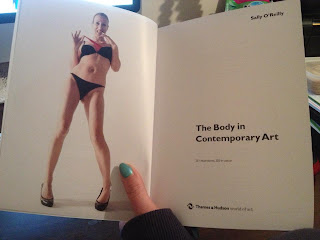
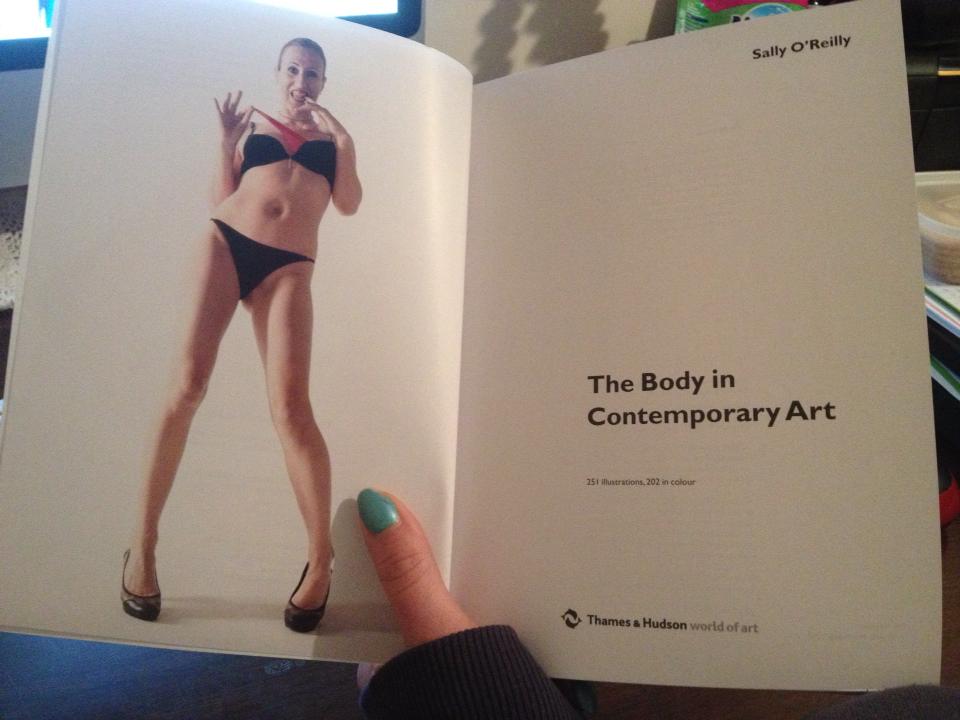
So, after my feedback from my Tutor I was told to buy this book from Amazon called 'The Body in Contemporary Art' by Sally O'Reilly Thames & Hudson world of art, because I got told it would be helpful to my research into the 'body' in photography. I have found the book very interesting and will always be a great book to have in my photography book collection, but there are only a few artists and images that I felt were relevant to my ideas and are very helpful. Here is my copy of the book below;


 So, Since I have had this book, I have briefly read about every image in the book and have selected the ones I feel I like the most. I have chosen images that are relevant to the 'Body' and the images most relevant to my ideas of body movement. Some of the images within this book are rather grotesque and some are quite disturbing once read about, so I have chosen some of the calm images as research.
 The first image that I thought was relevant to the 'body' was Edouard Manet's Olympia, 1863 (above left), because it shows the beginning of the female body being portrayed. It says in the book that, "the name Olympia was commonly adopted by prostitutes in the 19th century". The name is used to show the scandal of what was going on around her. Quite interestingly, the female in this painting was the 'type' of female that was considered unrepresentable.
I have chosen to put an image by Yasumasa Morimura Portrait (Futago), 1988-90 (above right) next to Manet's painting, and quite obviously because it is a re-creation of Manet's painting. Morimura slips into various historical, social and racial roles in re-staging a series of Old Master paintings. I think the idea of re-staging old paintings is quite interesting but only if the though of the exact role is considered. I have re-staged an old painting before and it's something I would consider doing again.
 The next image in the book related to the 'body' is Dorota Sadovska, Corporalities, 2003 (above left). It shows breasts "demystified and abstracted", but it also is an attempt to show how de-nuding them of sexual potency by treating them as a sculptural matter, reminds us of the medical necessity of self-examination. I think that it is a quite interesting concept and shows the body/nude in a very unique way. I think many nude images can be said to be de-nuding the body by hiding away certain body parts. It is definitely something to think about when I next do nude photography.
The image next to this is Bettina von Zwehl, Alina 1, 8, 9 and 11, 2004 (above right) which is more to do with body language than the body but still interesting. In this series of portraits each sitter is sat at a table in a darkened room and a piece of music is played, there is a single flash used to capture the way they react. They all sit with arms crossed in a white vest but whilst music is playing they all involuntarily look downwards. This could be an interesting subject in my ideas of what do dancer think about whilst dancing? which is my mixed media project ideas.
 Rineke Dijkstra is a photographer who's work I have looked at and studied a lot. The reason I have used her as inspiration before is for her 'deadpan' images of portraits on beaches. The simplicity also gives so much to think about when concentrating on the subject. Here her images (above left) are Tecla, Amsterdam, The Netherlands, May 16 1994, 1994, and Kolobrzeg, Poland, July 26 1992, 1992. In her beach series the clothed body out of the sea, shot against a neutral featureless seascapes, many of the subjects appear obvious to nationality stereotypes. The differences between sassy California swimsuits to prim dresses in south England, each are quite different and stereotypical. In the series of women who have recently given birth, she captures moments of vulnerability, and expressions of pride and relief after birth, Dijkstra manages to show expressions from her subject without even asking for it.
The image next to Dijkstra is by Katy Grannan, Austin, TX, 2000 (above right). This images shows how whether consciously or not, the language of the representation of the body influences our behaviour in front of the camera, Grannan approaches her subjects in public places like parks and asks them to pose as nudes and say what they think about 'art photography' then they arrange their bodies how they feel is right. This could work quite well for finding the differences in each person, is a way of showing that specific personality in a way.
 This image (above left) is by Vanessa Beecroft, VB.45.107dr, 2001. Beecroft see's live performance's as a commercial framework, this instillation of 'girls' as she calls the models, shows us her view on idealised beauty in real time and space. She draws on the feminist dematerialising strategies of the 1970's, although her outcome shows subjects in nude. She has done other installations of long-limbed slim beauties lounging among Louis Vuitton handbags which brought up feminists and anti-capitalists. Beecroft is involved with the fashion and beauty industries and the art market. The thing I personally find interesting and is mentioned is how the live installations last for hours, so therfore the models wilt and therefore show the lie to their image perfections - cracks to show the real body. This same idea could be portrayed in photography too, if shown the differences between idealised body types.
The image (above right) is by Robin Rhode, Untitled (Rings), 2006. "Serial photography animates these drawings on tarmac, so that they become dynamic events activated by the artists body. I really like these images and think that it is a really thought out and successful idea. It is something that I would like to try if I could get above my subject in the same way. The work was done to signify the worlds of street culture and graffiti, these rings drawn on the ground could be mistaken for road workers instructions, until the artist performs an illusion that transforms them into gymnastic rings. The stretches and flexes in real time and space show how it could look in real. New lines are drawn to almost look as if it is a storyboard animation, showing previous movements that are still visible.
This piece of work above right (robin rhode) is probably most relevant to my ideas of the body movement and how we see the body move.
 This image by Mona Hatoum, Pull, 1995 (above left) "subverbs our expectations of digital jiggery-pokery". With this installation the audience are invited in the tug on the hair braid hanging down, which is underneath a screen that shows the artists head upside down. With each tug on the hair the face shows shock and pain. I would think and as well the viewer thinks it would be a clever software editing that interacts with viewer and artwork but it is actually a live feed, the hair is the artists own hair attached to her head still and is sensitive. I think it's a great idea, really confusing the viewer and makes us think, but not the thought of someone tugging too hard!
The last image that I have decided to show from this book is by Jerome Bel, The Show Must Go On, 2001 (above right). This image also fits in well with my ideas of body movements because it is a dance show. "The performers wear everyday clothes and display an array of body types that are not expected to move with particular litheness or circumstances. Bel's choreography has more in common with banal, everyday gestures than the hyperbole of ballet. Here the performers have slumped to the ground to the soundtrack Killing Me Softly. Dance is a great way of showing how the body moves and many different body shapes and positions. This is why I have linked dance with my ideas. Here shows them all on the ground because of a particular piece of music, I would like to use a similar technique in my work and ask dancers to move in a certain way to music and see how their body moves. This artist, choreographer and images will be more useful to my Mixed Media ideas more-so than this module as I am linking the two ideas, but producing a film for mixed media.
Out of this book I have come away with 10 interesting and helpful ideas for working with the body. They have each different in their own way but have given me so many ideas to work with in the future. Some have been very relevant to my idea of movement, mostly:
Robin Rhode for actual body movements, shown in different ways, and
Bettina von Zwehl for the how the subconsciousness mind affects body movements.
But overall this will be one book of many to help me along with my research.


I have chosen to put an image by Yasumasa Morimura Portrait (Futago), 1988-90 (above right) next to Manet's painting, and quite obviously because it is a re-creation of Manet's painting. Morimura slips into various historical, social and racial roles in re-staging a series of Old Master paintings. I think the idea of re-staging old paintings is quite interesting but only if the though of the exact role is considered. I have re-staged an old painting before and it's something I would consider doing again.

The image next to this is Bettina von Zwehl, Alina 1, 8, 9 and 11, 2004 (above right) which is more to do with body language than the body but still interesting. In this series of portraits each sitter is sat at a table in a darkened room and a piece of music is played, there is a single flash used to capture the way they react. They all sit with arms crossed in a white vest but whilst music is playing they all involuntarily look downwards. This could be an interesting subject in my ideas of what do dancer think about whilst dancing? which is my mixed media project ideas.

The image next to Dijkstra is by Katy Grannan, Austin, TX, 2000 (above right). This images shows how whether consciously or not, the language of the representation of the body influences our behaviour in front of the camera, Grannan approaches her subjects in public places like parks and asks them to pose as nudes and say what they think about 'art photography' then they arrange their bodies how they feel is right. This could work quite well for finding the differences in each person, is a way of showing that specific personality in a way.

The image (above right) is by Robin Rhode, Untitled (Rings), 2006. "Serial photography animates these drawings on tarmac, so that they become dynamic events activated by the artists body. I really like these images and think that it is a really thought out and successful idea. It is something that I would like to try if I could get above my subject in the same way. The work was done to signify the worlds of street culture and graffiti, these rings drawn on the ground could be mistaken for road workers instructions, until the artist performs an illusion that transforms them into gymnastic rings. The stretches and flexes in real time and space show how it could look in real. New lines are drawn to almost look as if it is a storyboard animation, showing previous movements that are still visible.
This piece of work above right (robin rhode) is probably most relevant to my ideas of the body movement and how we see the body move.

The last image that I have decided to show from this book is by Jerome Bel, The Show Must Go On, 2001 (above right). This image also fits in well with my ideas of body movements because it is a dance show. "The performers wear everyday clothes and display an array of body types that are not expected to move with particular litheness or circumstances. Bel's choreography has more in common with banal, everyday gestures than the hyperbole of ballet. Here the performers have slumped to the ground to the soundtrack Killing Me Softly. Dance is a great way of showing how the body moves and many different body shapes and positions. This is why I have linked dance with my ideas. Here shows them all on the ground because of a particular piece of music, I would like to use a similar technique in my work and ask dancers to move in a certain way to music and see how their body moves. This artist, choreographer and images will be more useful to my Mixed Media ideas more-so than this module as I am linking the two ideas, but producing a film for mixed media.
_______________________________________________________________
Out of this book I have come away with 10 interesting and helpful ideas for working with the body. They have each different in their own way but have given me so many ideas to work with in the future. Some have been very relevant to my idea of movement, mostly:
Robin Rhode for actual body movements, shown in different ways, and
Bettina von Zwehl for the how the subconsciousness mind affects body movements.
But overall this will be one book of many to help me along with my research.
Subscribe to:
Posts (Atom)